How to Get Rid of Mold
Getting rid of mold means two things: removing the mold that is there, and fixing the moisture that let it grow. If you only do the first, the mold comes back. If you only do the second, the mold that is already there stays. The U.S. Environmental Protection Agency (EPA) guidance makes that order clear, and it also draws a practical line for homeowners: small areas on hard surfaces can sometimes be cleaned by a homeowner, while larger areas, porous materials and contaminated water call for a professional.
This post explains that line honestly, step by step, so you can tell whether your situation is a cleaning job or a job for a provider. It is general information, not medical advice. Mold Removal Experts LA is a referral service that connects customers with independent local providers; it does not perform mold work itself.
Step one: find the water
Mold needs moisture to grow, and the EPA notes that the moisture problem must be fixed for the mold problem to stay fixed. Before you clean anything, look for the water source. Check under sinks, behind toilets and showers, around windows, and on ceilings below bathrooms and kitchens. Note whether the patch grows after rain, after a shower, or after the air conditioning runs, because the timing points to the source. A patch that is damp to the touch, or that sits on a wall that feels cool and damp, is still being fed by water.
Common sources include slow plumbing leaks, roof leaks, condensation on ducts, poor ventilation in bathrooms and kitchens, and water entering through a foundation crack or retaining wall. Some sources are easy to see, such as a dripping trap under a sink. Others are hidden, such as a slab leak or a roof leak that only shows as a ceiling stain months later. If you cannot find the source, an inspection with moisture readings can trace it. Cleaning before the source is found is wasted effort, because the mold will return.
Step two: decide whether this is a DIY job
The EPA's rule is the clearest guide available. If the moldy area is smaller than about 10 square feet, on a hard, non-porous surface, and the moisture source is already fixed or is a one-off spill, a homeowner can sometimes clean it. If the area is larger than about 10 square feet, if the mold is on drywall, wood, carpet or insulation, if it is in a heating, ventilation and air conditioning system, or if it follows sewage or floodwater, the EPA recommends hiring a professional. That threshold is a practical line, not a legal limit, and it reflects how much contamination and how much hidden growth a larger patch usually involves.
There are also people for whom DIY is not the right choice even for a small patch. If someone in the home has asthma or another respiratory condition, is a young child, is pregnant, or has a weakened immune system, disturbing mold can be a problem, and a professional should be asked instead. The Centers for Disease Control and Prevention (CDC) notes that mold exposure can cause health effects in sensitive people, and that anyone with concerns should talk to a health care provider. This post does not give medical advice, and it does not diagnose or treat any condition.
Step three: clean a small patch safely
If the patch is small, on a hard surface, and the moisture source is fixed, cleaning can be done with water and detergent, or with a commercial mold cleaner labelled for the surface. Wear gloves and eye protection, ventilate the room, and avoid dry brushing or vacuuming the patch, because that can spread spores into the air. Scrub the surface, rinse if the product calls for it, and then dry the area completely. Drying matters as much as cleaning: a surface that stays damp will grow mold again, even after a thorough scrub.
Do not use bleach on a large area, do not mix bleach with ammonia or other cleaners, and do not use a household vacuum on mold. If the patch is on grout, remember that grout is porous, so cleaning may whiten it without reaching the growth inside. If the patch is on drywall, wood or carpet, cleaning the surface is unlikely to be enough, because the mold inside the material survives. In that case, the material usually needs to be removed and replaced, which is work for a provider. The bleach and vinegar posts on this site cover those two cleaners in detail.
Step four: dry the area and fix the source
After cleaning, the area must be dried completely, and the moisture source must be repaired. That may mean fixing a plumbing leak, repairing a roof, clearing a condensate drain, improving ventilation, or fixing drainage around a foundation. A dehumidifier can help in a damp room, but it is not a substitute for fixing a leak. If the wall or floor is still damp after a few days, the source has not been fixed, or the material is holding water and needs to be dried with professional equipment or removed.
Watch the area for a few weeks after cleaning. If the patch returns in the same place, the source is still active, or the material was not fully dried or removed. That is the point to stop cleaning and ask a provider for an inspection. A provider can take moisture readings inside the wall, check whether the material should be removed, and recommend testing or remediation where needed.
When to call a professional
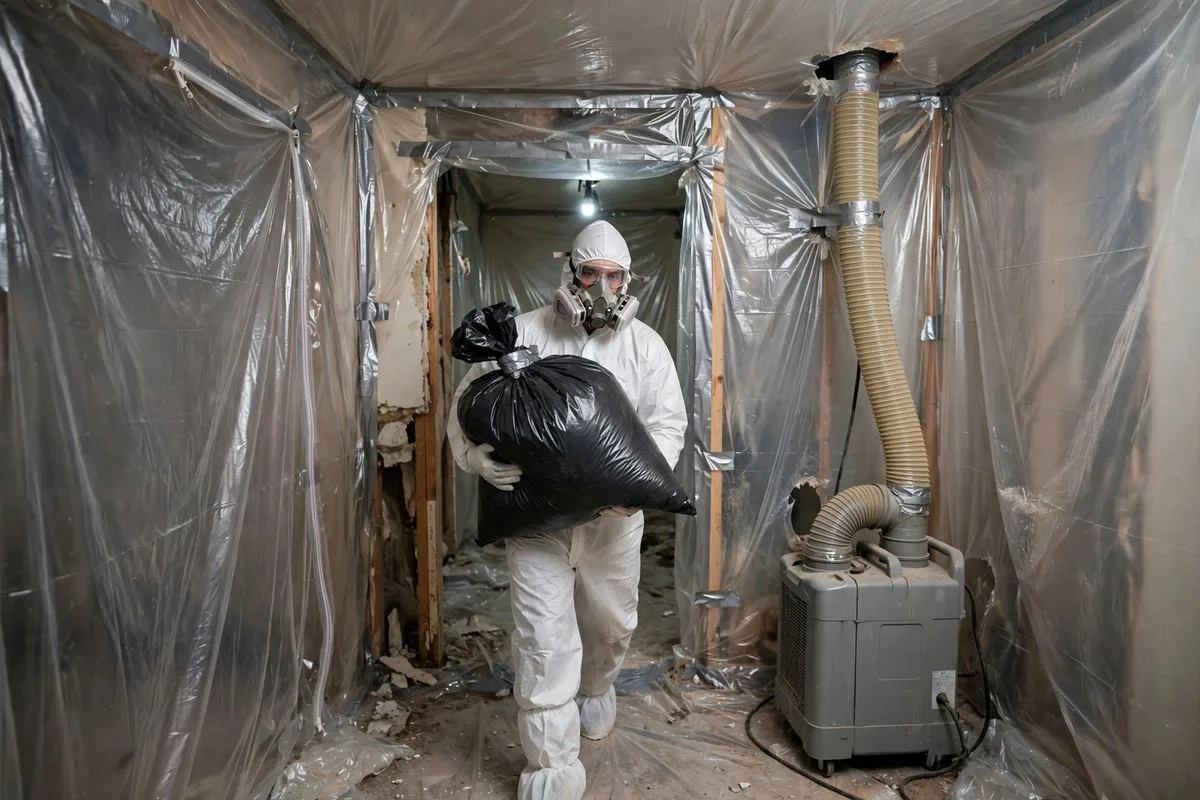
Call a provider if the patch is larger than about 10 square feet, if it is on drywall, wood, carpet or insulation, if it is in an air conditioning system, if it follows sewage or floodwater, or if it keeps returning after cleaning. Also call a provider if the source cannot be found, if the home is being bought or sold, or if someone in the home has a health concern that makes DIY cleaning inappropriate. A provider connected through this site can inspect the area, map the moisture, and recommend testing or remediation where needed. Remediation, where needed, generally involves containing the affected area, removing damaged porous materials, cleaning and drying, and confirming the area is dry before repairs are made. Post-remediation verification is a separate, independent check that the work is complete.
Older homes, companion hazards and other trades
Many Los Angeles homes with a mold problem were built before 1978, and in those homes removing mold can raise a second question. Asbestos was used in some building materials, including some insulation, floor tiles and joint compound, and lead paint was used in homes built before 1978. Opening a wall or removing material can disturb those materials, so a provider should be asked how they handle that risk, whether testing is needed before demolition, and whether a specialist is brought in. Mold Removal Experts LA does not offer asbestos or lead testing or abatement, and mold providers do not offer it as part of mold work; where those hazards are suspected, a specialist in that field is the right call, and a mold provider can coordinate with them.
A mold job often involves other trades as well. A roof leak needs a roofer, a plumbing leak needs a plumber, and mold in an air duct or heating and cooling system may need an air-duct and HVAC restoration specialist to clean and restore the system after the mold is removed. Those are adjacent trades, not mold services. Ask a provider what their scope covers, what they coordinate with other trades, and what should happen after their work is done, so that the leak is fixed and the system is restored rather than only the visible mold being treated.
What getting rid of mold permanently actually takes
Mold is removed permanently only when three things happen together: the moldy material is cleaned or removed, the area is dried completely, and the moisture source is fixed. Any one of those alone is not enough. A cleaner without a moisture fix leaves the cause in place. A moisture fix without cleaning leaves the mold that is already there. And drying without removing damaged porous material leaves growth inside the material. That is why the post on what kills mold permanently focuses on the moisture fix rather than the cleaner, and why the post on what kills black mold permanently makes the same point for dark-coloured mold. If you remember one sentence from this post, make it this one: fix the water, then clean or remove the mold, then dry the area, and watch it.
Published:
Related pages
Frequently asked questions
What if the mold is behind a wall I cannot see?
A provider can use a moisture meter and, in some cases, a thermal camera to find damp areas inside a wall without opening it first. Those tools show where moisture is, not what species is present. If the readings show a wet area behind a wall, the provider can advise whether a small opening is needed to inspect it, and how to do that without spreading spores.
Can I stay in my home while mold is being removed?
That depends on the size of the job, where it is, and who lives in the home. Providers usually contain the work area with sheeting and negative air pressure to limit spread, and people with respiratory conditions, young children or weakened immune systems are often advised to stay out of the work area. Ask the provider what containment they use and whether anyone should leave during the work.
Does homeowners insurance cover mold removal?
It depends on the policy and on what caused the mold. Sudden and accidental water damage is often treated differently from long-term neglect, and flood damage is usually excluded from a standard homeowners policy. This site has an insurance guide that explains those distinctions in general terms; it is general information, not insurance advice, and the policy itself is the document that decides.
How do I compare quotes from different mold providers?
Ask for a written scope based on the same inspection report, so that each provider is quoting the same defined work: the same area, the same materials to be removed, the same drying standard, and the same clearance check. Quotes for different scopes cannot be compared fairly, and the cheapest quote for a smaller scope is not the same job as a fuller quote.
Should I get a mold inspection before buying a home?
It can be a useful step, especially for an older home, a remodelled bathroom or kitchen, or any staining or musty smell. A mold inspection looks specifically for moisture and growth, and it can document the problem before closing, which gives a buyer a written record to use in negotiations or in planning repairs.
Need mold help in Los Angeles?
Tell us where the mold is and how large the area looks. We will connect you with an independent local provider.
Request a referral Call (945) 422-7665
Mold Removal Experts LA is a referral service. We do not perform mold inspection, testing, or remediation. We connect you with independent local providers who do the work.